Safety glass is what we are set up for
A London glass processor with its own toughening in Wembley.
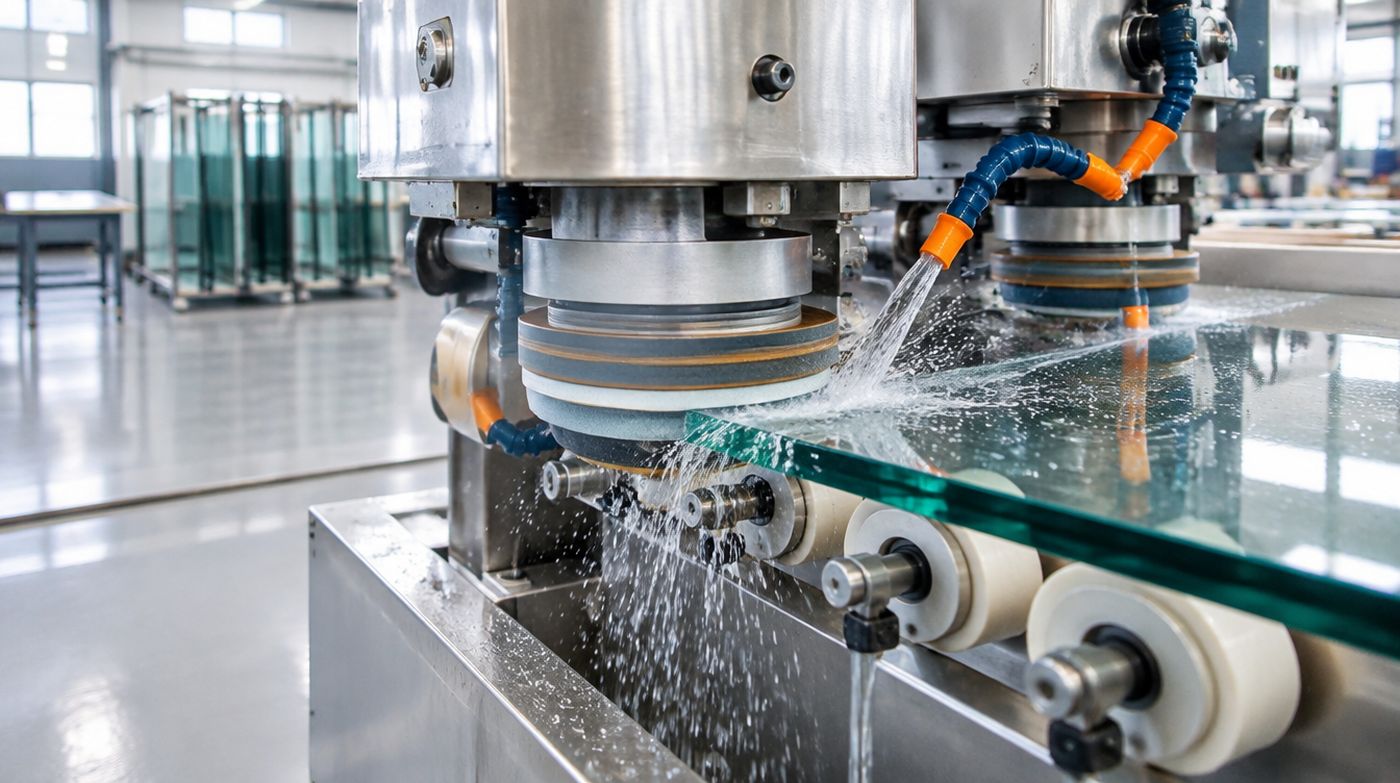
A glass workshop with its own furnace, not a middleman with a van
London Toughened Glass is a glass processor and installer based at 6 Atlas Road in Wembley. We cut, edge, polish, toughen and laminate glass ourselves, make up sealed units, and install with our own teams. That single fact shapes everything else on this website, because a company that makes the glass answers different questions to a company that orders it in.
When you ring a merchant who buys in processed glass, the honest answer to most technical questions is that they will have to ask. What thickness will survive that span. Whether that pane can be toughened at all given its size and the hole positions. Whether the distortion direction can be matched to the pane next to it. Whether heat soaking is worth the extra fortnight. We answer those on the phone because the furnace is behind us.
What actually happens in the workshop
Glass arrives as stock sheet. It is cut, then the edges are worked, and that is the stage most people never think about and the one that decides whether a pane survives. An arrissed edge takes the sharpness off and is used where the edge is hidden in a frame. A ground or polished edge is for glass you can see and touch, like shelves and toughened glass table tops. Holes and notches are drilled and milled before toughening, because after toughening nothing can be touched.
Then the pane goes through the furnace, heated to around 620°C and quenched hard with air. The surface locks into compression and the core into tension, and the result is a pane several times stronger than it was and one that breaks into small blunt pieces. It comes out permanently marked. Where heat soaking is specified, it goes through a second controlled cycle to BS EN 14179 to flush out panes with unstable inclusions before they leave the building.
We also laminate, which matters because the honest answer to a lot of enquiries is that toughened glass is the wrong product. Overhead glazing, balustrades and anywhere retention matters want laminated glass to BS EN 14449. Being able to make both means we have no reason to push you towards one.
Why we quote from a survey and not from a photograph
You can get a price from a photograph. You cannot get a price that will still be true when the glass arrives. Old London openings are not square, frames have moved, beading has been replaced with something that holds a different thickness, and a broken pane tells you very little about what was originally cut. We have measured plenty of openings that were 6mm different top to bottom in a 900mm span.
So the survey is free, across Greater London, and the quotation that follows is written and fixed. Fixed means the figure on the paper is the figure on the invoice unless you change the specification. If we have measured it wrong, that is ours to put right, which is the whole reason the survey exists.
FENSA, standards and the paperwork worth keeping
We are a FENSA registered installer, which is the self certification scheme covering replacement windows and doors under the building regulations. It matters when you come to sell, because a conveyancing enquiry about replacement glazing is far easier to answer with a certificate than with an explanation.
Separately, keep the specification. A quotation and invoice that name the product standard, the thickness and the safety class for each opening is a compliance record. Combined with the permanent mark on the glass itself, it answers a surveyor, a letting agent, an HMO licensing officer or a loss adjuster without a site visit. We write quotations opening by opening for exactly that reason, rather than giving one lump sum for the whole house.
What we will not do
We will not supply monolithic toughened glass for overhead glazing or for a barrier that has to perform after the glass is broken. We will not quote toughened glass for every opening in a house when only some of them are critical locations. We will not cut, drill or grind a toughened pane after the fact, whatever the deadline is, because weakening the compressive layer on a pane in a door is dangerous and no amount of pressure changes that.
We will also tell you when there is nothing to buy. If a window keeps cracking because a backing board is pressed against it or a radiator sits 30mm from low level glazing, the answer is to move the board or the radiator. We have walked off surveys having recommended nothing. It costs us a job and earns the next three.
If another quote has toughened glass in every opening with no explanation of which positions are critical locations and why, ask for that breakdown. If it does not come back, you have learned something useful about the quote.
How a job runs from first call to glazed opening
A broken pane and a planned replacement run differently. For a breakage, the first conversation is about making the opening safe and whether it needs boarding today, especially for a shop or a ground floor flat. We would rather talk you through clearing it safely than have you pull a slab of fragments down on yourself while waiting for us.
Then a surveyor measures the opening, records the frame type, the glazing method, the beading, every fitting position and whether the frame is square and sound. You get a written quotation listing each pane with its thickness, standard and class. On acceptance the glass is cut and processed in Wembley, and because the furnace is ours we know where a job is instead of chasing a supplier.
Installation is by our own teams. Nobody is subcontracted, which is the only way to keep the standard of edge clearance, packing and setting blocks consistent. Badly packed toughened glass is a pane sitting on a point load, and point loads find the edge.
Who we are useful to, and who should ring someone else
We are useful to homeowners who have been told their glazing does not comply and want to know which panes rather than a scare story. To landlords and agents with a portfolio of London conversions and HMOs who need glazing audited and documented. To shopfitters and retailers who need a frontage panel remade accurately and distortion matched across a run. To builders and joiners who want holes, notches and patch fitting cut outs processed properly before toughening. To anyone who needs a toughened glass supplier in London that can be held to a measurement.
We are not the right people for a single small pane on the far edge of the M25 when there is a decent processor two streets from you. We are strongest in north, west and central London and we cover Greater London. If the honest answer is that somebody closer should do it, we will say so on the phone rather than quote a price that includes two hours of traffic.
Thicknesses, sizes and the limits we work to
There is no single right thickness. A 4mm toughened pane is fine in a small internal door panel and hopeless in a 1.8 metre side screen. Thickness is chosen from the span, the way the pane is supported, the exposure to wind on an external elevation and what is likely to hit it. On shopfronts and large side screens that usually means 6mm, 8mm or 10mm, and on a frontage where a trolley or a shutter will catch it, thicker again. Shelves and toughened glass table tops are chosen from the span between supports and the load, not from what looks substantial in a showroom.
Size has limits too, and they are not only about the furnace. A pane has to be carried to the opening by people, often up a stair, round a return or through a flat, and a 10mm pane two metres square is a serious weight. Where an opening is bigger than a pane can sensibly be handled, the honest answer is to change how the opening is divided rather than to make a pane that will be dropped. We work that out at survey, with the route in mind.
Lead times, and why nobody toughens glass in an hour
Toughening is a thermal process on a schedule. The glass is cut, the edges are worked, holes and cut outs are machined, and only then does it go through the furnace. Heat soaking to BS EN 14179 adds a further controlled cycle measured in hours, not minutes. That is why a replacement toughened pane is a matter of days rather than the same afternoon, and why an emergency call usually splits into boarding now and glazing shortly after.
We would rather give you a date we can hold than a date that sounds good on the phone. If a pane is going to take longer because it needs heat soaking or an unusual size, you will be told at quotation, along with what boarding or temporary glazing will cost in the meantime.
Workshop and processing: 6 Atlas Road, Wembley, London HA9 0JH. Office hours Monday to Friday, 8am to 5pm. Phone 020 4634 6045 and you will get someone who can answer a question about glass rather than take a message about one.
Get a price for your toughened glass
Send sizes and tell us where the glass sits. We will confirm whether safety glass is a requirement and quote in writing.