Toughened glass table tops, cut to your shape and edged to suit
A glass top is the one glazing job where the edge and the corners matter as much as the glass. This page covers how to choose thickness, finish and radius, and which of the upgrades are worth paying for.
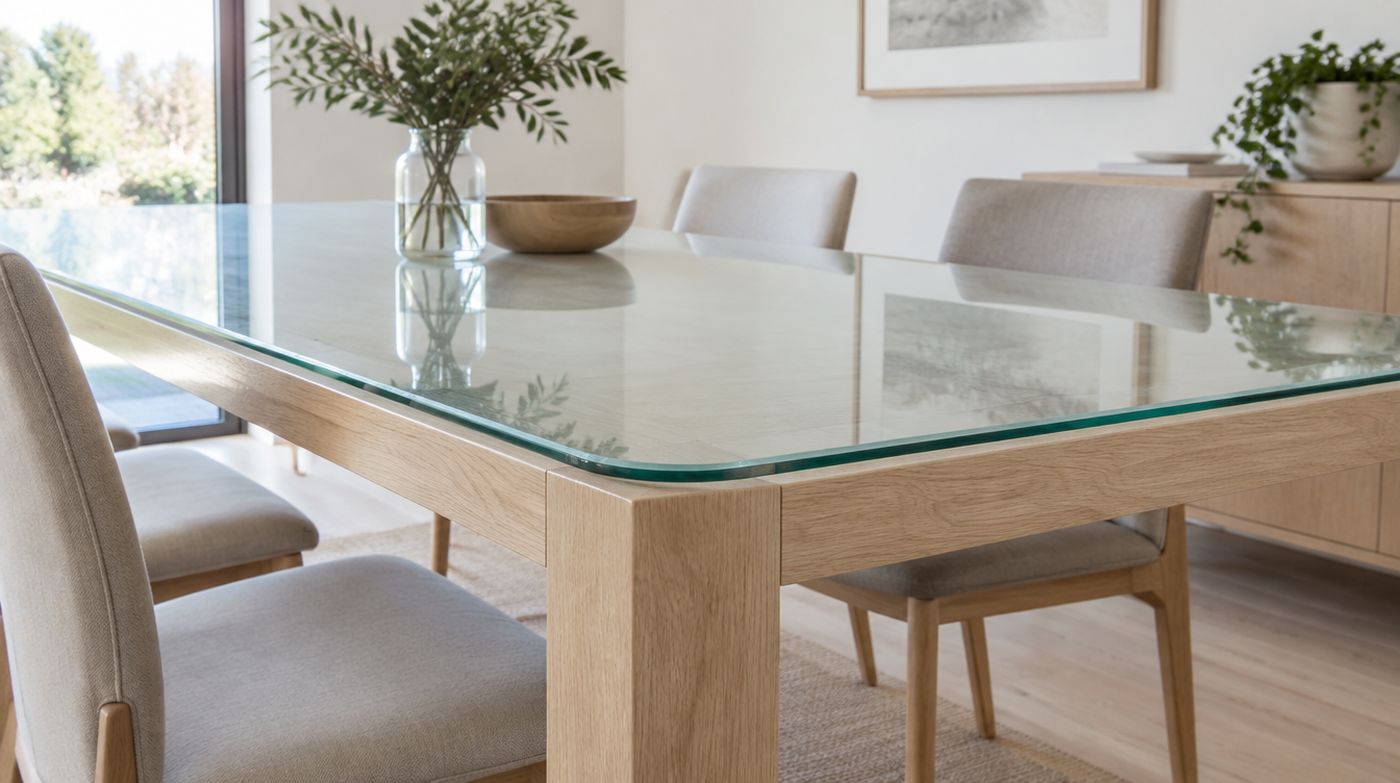
A top and a protector are two different products
Toughened glass table tops divide cleanly into two jobs, and confusing them is the most expensive mistake people make. The first is a protective sheet laid over an existing solid table, to take the heat, the spills and the scratches. The second is the table top itself, usually glass on a metal or timber base, where the glass carries everything and has nothing beneath it.
A protector sits on something continuous, so the glass does very little structural work. 6mm toughened is genuinely enough for most of them and is what we supply most often. People are frequently quoted 10mm for a protective sheet over a solid oak table, which adds weight, cost and nothing else. If that is your job, ask why you are being sold the thicker glass before you pay for it.
A top with a base underneath it is a different calculation entirely, because the span between supports, the overhang beyond them and the loads people actually put on a table all come into play.
Choosing thickness for toughened glass table tops
For a dining or coffee table with the glass spanning a central pedestal or a pair of trestles, 10mm is the standard and sensible choice for most domestic sizes. It gives enough stiffness that the top does not feel lively when someone leans on an edge, and it is still a weight two people can handle.
12mm is the right answer where the span between supports is long, where the overhang beyond the base is generous, where the top is unusually large, or where the table will take a hammering in a commercial setting. A café table in a shop unit on Kilburn High Road is a 12mm job for wear and confidence rather than for calculation.
15mm and 19mm tops exist and look substantial, and we will make them. Honestly, on a domestic table they are usually about appearance rather than need, and the weight becomes a real consideration: a 19mm top is close to twice the weight of a 10mm top of the same size, which affects the base, the floor and anybody trying to lift it to clean underneath. If someone has specified 19mm for an ordinary dining table, ask them what it is solving.
The other half of the answer is the base. Toughened glass is strong in bending but it is point loads that break tops, so a base with four small hard pads under a large thin top is a worse arrangement than a base with a continuous rim under a thinner one. We look at the base as part of the quote, not as an afterthought.
Overhang, support and where tops actually break
Breakages on glass tops almost never happen in the middle. They start at an edge or a corner, usually from a knock, a nip against a hard metal fixing, or someone sitting on an unsupported overhang. Toughened glass is extremely strong across its faces and comparatively vulnerable at the edge, because that is where the compressive skin is thinnest and where any chip goes straight into the tension.
So the practical rules are: keep the overhang beyond the base modest, never let the glass sit directly on bare metal or on a hard point, and treat the edge as the thing to protect. A chip in the edge of a toughened top is not cosmetic. It is a pane waiting to go, and no filler or polish will fix it, because the pane cannot be ground after toughening.
Edges: arrised, polished, pencil or bevelled
All four edges of a table top are visible and touchable, so this is one of the few jobs where the edge finish genuinely matters. An arrised edge, with the sharpness simply taken off, is fine for a protector that will sit under a cloth or inside a timber lip. A flat polished edge, ground and polished flat with a small arris top and bottom, is the normal choice for a glass top and is what we would fit on most tables.
A pencil polished or round polished edge is softened to a curve. It feels better under a forearm, it is more forgiving of knocks, and it is the one we recommend where there are small children in the house. A bevelled edge, cut back at an angle and polished, looks traditional and catches light attractively, and it costs more and takes longer because the grinding is slow.
The honest advice on bevels is this: specify one on a freestanding glass top where the edge is on display and you want it, and skip it entirely where the glass drops inside a timber frame or a recessed lip, because the bevel will be hidden and you will have paid for it twice over in money and lead time. The same goes for a protector that sits flush into a rebated table. We get asked for bevels on recessed tops reasonably often and we check before cutting.
Corners and radii
A square 90 degree corner on a glass table top is an exposed point in the most vulnerable part of the pane, and it is the thing that catches a hip or a shin. We radius the corners on almost every top we make. A small radius keeps the top looking square while taking the point off. A larger radius reads as a deliberately rounded corner and suits a kitchen table or anywhere people move past it in a hurry.
Radii are ground before toughening like everything else, so they have to be decided in advance. If your base has a particular shape, or the top needs a notch around an upright or a cut-out for a parasol, that too is template work and not a dimension on a sketch. We cut templates on site for anything that is not a plain rectangle, oval or circle.
Clear float or low iron
Standard clear float glass carries a faint green cast from the iron in the raw materials, and the one place you reliably see it is the polished edge of a thick pane. On a 12mm top with a flat polished edge, the edge will read as pale green, particularly against a white wall.
Low iron glass removes most of that at a premium, and a glass table top is one of the few domestic jobs where it is honestly worth considering, because the edge is on display from every seat. Whether it is worth it depends on the base: over a dark walnut table or a black metal frame the green edge is invisible and low iron is wasted money. Over a white base, a pale stone floor or a light timber top it makes a visible difference. Tell us what it is going on and we will give you a straight answer rather than defaulting to the upgrade.
Pads, grip and stopping the glass moving
Glass should never sit metal to glass or glass to a hard point. Clear self adhesive pads in the corners and along the bearing line do three jobs: they spread the load, they stop the top sliding when someone leans on it, and they keep a hair of air between the glass and a timber surface so moisture does not get trapped. They cost very little and they prevent the kind of point loading that takes tops out.
On a protector over timber, pads also stop the glass gripping a polished finish and lifting it when the top is moved. On a metal base, a continuous strip of soft setting material under the bearing edge is better than four dots.
What a glass top will look like, honestly
Toughened glass passes through the furnace on rollers, and that leaves a faint waviness in the surface called roller wave. On a vertical panel you will never see it. On a horizontal table top lit from a window, looked along at a shallow angle, you may. It is inherent to toughening, every processor has it, and no amount of money removes it.
You may also see soft shadowy patterning in bright light or through polarised sunglasses. That is the quench pattern and it is evidence the glass really is toughened. If flawless optical flatness is the priority over strength, annealed glass is flatter, but it breaks into shards and we would not put it on a table where people eat.
Shapes, sizes and getting it home
We make toughened glass table tops as rectangles, squares, circles, ovals, racetracks and one-off shapes cut from a template, with any corner radius, in our own workshop at Atlas Road in Wembley. Round tops and ovals are drawn and cut rather than templated if you can give us the dimensions and confirm the base.
The practical limit is handling. A 12mm top 1.8 metres long is heavy and awkward and it needs two people and a clear route, which in a top floor flat in Camden or a terraced house in Walthamstow with a tight return on the stairs is worth thinking about before you order. Our teams deliver and fit across London, and if the size you want cannot sensibly get into the room we will say so at the survey rather than at the door.
FAQ
Questions about toughened glass table tops
How thick should a toughened glass table top be?
For a protective sheet laid over an existing solid table, 6mm is enough because the table underneath does the work. For glass that is the table top itself, 10mm is the standard choice for most domestic dining and coffee tables, giving enough stiffness that the top does not feel lively when leant on. Use 12mm where the span between supports is long, the overhang beyond the base is generous, the top is unusually large, or the table is in commercial use. 15mm and 19mm are mostly about appearance on a domestic table and add considerable weight.
Should a glass table top have polished or bevelled edges?
Flat polished is the normal choice and suits almost every freestanding glass top. A pencil or round polished edge is softened to a curve, feels better to lean on and is more forgiving of knocks, which makes it the better option where there are young children. A bevelled edge is a decorative choice that costs more and takes longer to grind, so it is worth it only where the edge is on display. If the glass drops inside a timber frame or a recessed lip, the bevel is hidden and the money is wasted, so specify a plain polished edge instead.
Do toughened glass table tops need rounded corners?
We radius the corners on nearly every top, and we would recommend it. A square corner on a glass top is a sharp point in the most vulnerable part of the pane, both for people walking past and for the glass itself, because a chipped corner on toughened glass cannot be repaired and leaves a top that may fail later. A small radius keeps the top looking square while removing the point; a larger radius gives a visibly rounded corner that suits a kitchen table. Radii are ground before toughening, so the size has to be decided when you order.
Get a price for your toughened glass
Send sizes and tell us where the glass sits. We will confirm whether safety glass is a requirement and quote in writing.