Toughened glass cut to size, measured and made in Wembley
Every pane of toughened glass cut to size is made once and cannot be altered afterwards. This page sets out exactly what we need from you, and what we check, before anything goes near the furnace.
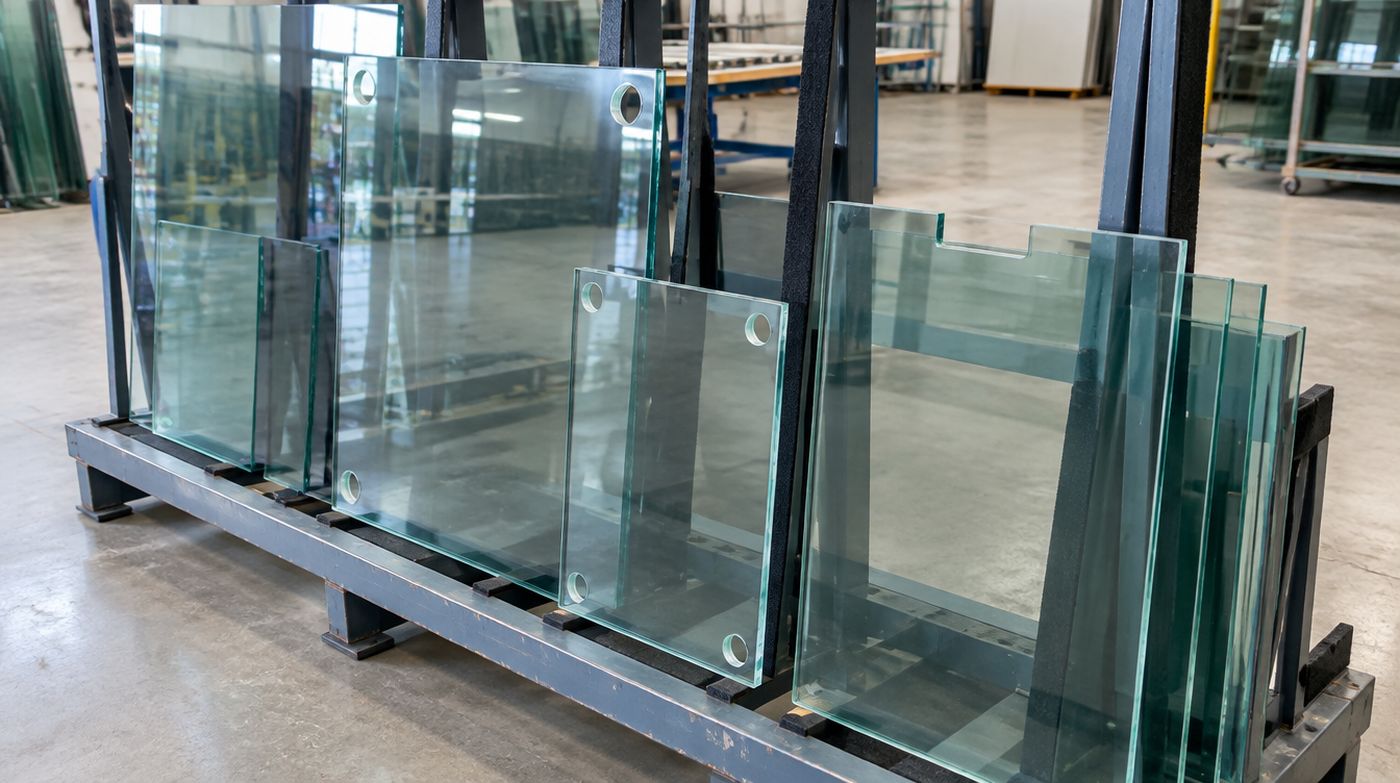
Why the size you give us is the size you live with
Toughened glass cut to size is made in a single pass. The sheet is cut from stock, the edges are worked, any holes or notches are machined, and then the whole pane goes through the furnace at around 620°C and is quenched with cold air. That locks a layer of compression onto both faces and leaves the core in tension, which is what makes the glass strong and what makes it break into small blunt pieces rather than long shards.
It also means the pane is finished. Nobody can take two millimetres off a long edge afterwards. Nobody can drill a hole for a handle, notch a corner around an architrave, or ease a tight fit with a wet wheel. Attempt any of it and the stress releases and the pane turns into a heap of fragments on the floor.
That is the whole reason we ask more questions than a merchant selling annealed glass by the square metre. An error in annealed glass costs a recut. An error in toughened glass costs the pane, and on a processed pane it costs the processing too.
Aperture size and glass size are not the same number
The opening and the glass are two different measurements and the gap between them is deliberate. Glass needs clearance to sit in a frame without touching the rebate, because buildings move, timber swells and a pane pinched hard at one corner will eventually break from that corner. It also needs room for the glazing method, whether that is tape, putty, silicone, a gasket or a bead.
Glazing into a rebate
If the glass is dropping into a timber, aluminium or uPVC rebate, measure the full rebate size at several points, then deduct a working clearance from both the width and the height. On ordinary domestic frames that deduction is a few millimetres in total, not a token half millimetre, and the pane should land on setting blocks rather than directly on the bottom of the rebate.
Check the diagonals while you have the tape out. Victorian and Edwardian sashes and casements across the inner London boroughs are rarely square, and where the diagonals differ by more than a couple of millimetres we cut to the smaller dimensions and take the difference up in the bead. A perfectly cut pane that will not drop into a racked frame is still a wasted pane.
A free edge, a shelf or a worktop
Where the glass has no frame, the ordered size is the finished size and there is no clearance to hide an error in. A shelf is cut to the bracket span, a splashback is cut to the wall opening less a silicone joint at each end, and a table top is cut to the overhang you want. Tolerance matters far more here, because two millimetres against a tiled upstand is visible and two millimetres inside a rebate is not.
Anything that is not a rectangle
Arched heads, raked panels under a staircase, splayed bay returns and anything that has to run around a pipe or a newel post need a template rather than dimensions. We cut templates in rigid board on site, mark them for face and orientation, and cut the glass against the template. People often want to send a drawing with angles on it instead. Angles on paper and angles in a hundred year old terrace in Islington are not the same thing.
What we need before we can quote toughened glass cut to size
A price for toughened glass cut to size is never just a rate per square metre. Each of the following changes the price, the lead time, or both, and a missing one is how orders go wrong.
- Width and height in millimetres, and whether those are glass sizes or opening sizes.
- Thickness, or simply what the glass is for if you are not sure which thickness is right.
- Glass type: clear float, low iron, obscure, tinted, satin or back painted.
- Edge finish, and which edges will actually be visible once it is installed.
- Holes, notches, cut-outs and radiused corners, dimensioned from a named edge rather than described in words.
- Whether the pane sits in a critical location under Approved Document K, which decides whether it has to be safety glass at all.
- Whether you want it heat soaked.
- How it is getting into the building, because a 12mm pane two metres long needs two people and a clear route.
How accurate is cut to size, in practice
Toughening introduces its own small distortions and the industry works to tolerances that reflect that. On ordinary domestic sizes you should expect the finished pane to be within a couple of millimetres of the ordered dimension, with slightly more allowance on thicker or larger panes. That is not carelessness, it is the physics of a sheet of glass going soft in an oven and riding over steel rollers.
Those rollers leave a faint waviness in the surface, usually called roller wave. You will never see it in a door panel or a splashback. You will see it in a large pane viewed in reflection at a shallow angle, and you will see it along a glass table top looking towards a window. Anyone who promises you a perfectly flat toughened pane either has something to sell or has never stood next to a furnace.
You may also notice faint shadowy patches or stripes in certain light, particularly through polarised sunglasses. That is anisotropy, the optical fingerprint of the quench pattern. It is evidence the glass genuinely is toughened rather than a defect worth arguing about, and no processor can eliminate it.
Edge finish: what to pay for and where not to bother
Everything we toughen has its edges worked before it goes in the oven, because a raw cut edge is sharp, fragile and a reliable way to lose a pane in the furnace. The real question is how far to take that work.
If the glass is going into a frame and the edge will never be seen, an arrised or ground edge is all it needs, and paying for a flat polished finish on four hidden edges is money you will never see again. If one long edge is exposed, polish that edge and arris the other three. Tell us which edges show and we will quote it that way. Full polishing on a fully framed panel is one of the easiest things to be oversold, and it comes up constantly on door side screens in new flats where every edge disappears behind a bead.
Bevelled edges belong on mirrors and table tops and almost nowhere else in a house. They also take time on the machine, so they lengthen lead times. Decide before you order, because the bevel has to be ground before toughening along with everything else.
Holes, notches and cut-outs all happen first
Holes for handles, locks, standoff fixings, patch fittings and cable runs are drilled into the annealed sheet and the glass is then toughened around them. This is why we are fussy about positions. There are practical limits on how close a hole can sit to an edge, to a corner or to another hole, generally expressed as multiples of the glass thickness, and a hole placed too close in will either break in the furnace or become the weak point that fails two years later for no apparent reason.
If you are replacing glass in an existing fitting, give us the fitting itself or a dimensioned template taken from the old pane rather than the manufacturer’s catalogue drawing. Fittings get installed a few millimetres off nominal all the time. We go into the door side of this properly on our toughened glass for doors page.
Lead times, and what actually drives them
Clear toughened glass in ordinary thicknesses and ordinary sizes is a matter of a few working days from our Wembley workshop, because we cut, edge and toughen it ourselves rather than buying it in and waiting on someone else’s oven. What stretches a lead time is processing, not size. Low iron glass, back painted glass, bevels, several holes, tight radii and heat soaking all add steps, and heat soaking adds a separate cycle in a second oven.
So if a supplier quotes a same day turnaround on a heat soaked low iron pane with polished edges and six holes, ask them which part of that they are not actually doing. And if you are being charged a rush premium for a standard clear pane in a standard thickness, challenge it. There is nothing in that order to rush.
Who carries the risk when a size is wrong
If you give us the sizes, the sizes are yours. If we survey, the sizes are ours, and a remake is on us.
That is worth stating plainly because it is the part most quotations leave vague. Trade customers who measure apertures every week usually prefer to send their own sizes and own the risk, and that is the quicker and cheaper route. A homeowner replacing a broken panel in a front door in Kensal Rise or Crouch End is usually better off having us measure, because the survey across London costs nothing and a remade pane costs real money.
Either way, the written quotation lists every pane with its size, thickness, glass type, edge finish and hole positions, so there is a document to check before anything is cut. Read it properly. Five minutes spent checking a dimension on paper is the cheapest five minutes in the job.
When toughened glass cut to size is the wrong order
Toughened glass is strong, it is a safety glass when it carries the right mark, and it is the default for door panels, low level glazing and screens. It is not the answer to everything. If a pane needs to stay in its opening after it breaks, as overhead glazing and many barriers do, laminated glass is the correct product and we treat that as a separate subject rather than bending this one to fit.
If the glass is going into a cabinet door, a picture frame or a high level window well clear of any critical location, ordinary annealed glass cut to size is cheaper and entirely legitimate, and plain glass cutting is covered on its own site rather than here. We would far rather say that at the quoting stage than sell you toughening you did not need. The one place we will not bend is a critical location under Approved Document K, where the glass has to be safety glass and has to be permanently marked to prove it.
FAQ
Questions about toughened glass cut to size
How do I measure for toughened glass cut to size?
Measure the opening, not the old pane, and say which you are giving us. For glass dropping into a rebate, measure the full rebate width and height at two or three points, use the smallest readings, then allow a working clearance of a few millimetres in total on each dimension so the pane is not pinched. Check both diagonals to see how square the opening is. For glass with free edges, such as a shelf or splashback, the size you give is the finished size, so allow for a silicone joint where it meets tile or render. Anything that is not a rectangle needs a template cut on site.
What tolerance should I expect on toughened glass cut to size?
On ordinary domestic panes, expect the finished size to be within roughly a couple of millimetres of the ordered dimension, with a little more allowance on thicker or larger panes. The furnace is the reason: the glass softens and travels on steel rollers, so size, flatness and squareness all carry small tolerances. That is also why you should never order a pane at the exact rebate size. Alongside size tolerance you should expect faint roller wave visible in reflection on large panes, and some optical patterning in polarised light. Both are normal in toughened glass and are not defects.
Can I order toughened glass cut to size without a site survey?
Yes, and plenty of trade customers do. Send the sizes, thickness, glass type, edge finish and any hole positions, and we will quote from that and list every detail back to you on the written quotation. The trade-off is risk: when you supply the sizes, an error in them is yours, and a toughened pane cannot be trimmed to fit. If the opening is awkward, out of square, arched or raked, or if you are replacing glass that works with existing fittings, take the free survey instead. We measure across Greater London and then the dimensions are our responsibility.
Get a price for your toughened glass
Send sizes and tell us where the glass sits. We will confirm whether safety glass is a requirement and quote in writing.