Safety glass in London
Where the regulations require safety glazing, what they actually say, and how to tell whether what is in your building complies.
What counts as safety glass in London, and where you are required to have it
Safety glass in London means one of two things in practice: thermally toughened glass made to BS EN 12150, or laminated glass made to BS EN 14449. Both can satisfy the impact performance classes in BS 6206, and it is the class on the pane rather than the word toughened that tells you whether a given position in a building complies. We supply, process and install both from our own workshop in Wembley, and most of what we do is either specifying safety glass into positions that never had it, or replacing toughened glass panels that have broken.
Approved Document K sets out the positions the regulations treat as critical locations. The short version is low level glazing in walls and partitions, glass in doors and the panels immediately beside them, and the zones around them where a person is likely to fall against the glass. The useful version is knowing how to check your own building, because that is what nobody explains.
How to read the permanent mark on a pane of glass
Toughened glass is marked permanently at one corner. The mark survives cleaning, decades of weather and, eventually, the frame it sits in. On a double glazed unit it may be on the inner surface of the outer pane, which means looking at it through 4mm of glass and a cavity, so take a torch. It is rarely in the middle of a pane and almost always within 100mm of a corner.
Read the mark element by element. The processor name tells you who made it, which is useful when you want a visually matching pane for a neighbouring opening. The standard reference tells you what it was made to. The class reference tells you what impact performance it achieved. The presence of BS EN 14179 tells you it was heat soaked. What matters for compliance is that the pane carries a product standard and a safety class you can point at.
How to check whether the glazing in a house or shop already complies
Work through the building opening by opening rather than room by room. Start at every door. Any glazed panel in a door, and any glazed panel in the wall immediately beside that door, needs to be safety glass. Check the corners of each panel for a mark. Then take a tape measure to every pane of glass in a wall, partition or screen and measure from floor level to the bottom edge of the glass. Low level glazing is the second big group, and in older London houses it is usually stairwell and landing glazing, glazed partitions in converted flats, and the full height windows added during 1980s conversions.
Note down the openings with no mark. Then separate them into glass that is staying as it is, which you are generally not obliged to change until you alter it, and glass you are about to replace, reglaze or disturb, which must go in as safety glass. That distinction is what calms down most sale and letting disputes. The usual outcome of a careful walk round is a handful of panes rather than a whole house.
Door panels, side screens, low level and full height glazing
Door panels and side screens are the single most common job we do. A toughened glass panel for a door has to be cut accurately to the rebate, processed to the right edge finish, and sized with the correct edge cover and clearance so it is not pinched when the frame moves. Toughened glass for doors takes more abuse than any other glass in a building: slamming, flexing, people pushing on it, trolleys and buggies hitting it. It is also where an unmarked annealed pane is most dangerous, because a person going through a door at walking pace meets the glass with their whole body.
Full height glazing and low level glazing need the same treatment with more attention to the frame. If a pane has broken in a stairwell or a landing we want to know whether it broke from impact, from thermal stress or because the frame has twisted and loaded it. Replacing the glass and ignoring a frame that is out of square buys you a few months at best.
A panel has just shattered. What to do in the first hour
Toughened glass breaks into small blunt fragments, which is the point of it, but a shattered pane in a frame is still a hazard. Get people away from the opening first, especially children and anyone barefoot, then deal with the glass that is still in the frame. Fragments cling together in a sheet and come out in slabs when disturbed, which is the moment most injuries happen. Gloves, eye protection, and do not pull at it from below.
Then make the opening safe rather than tidy. Clear what has already fallen, board or sheet the opening if it is an external pane or a shopfront, and leave fragments that are still bonded in place if removing them is going to bring a slab down on you. For a shop, boarding is also a security and insurance question, and a loss adjuster will expect to see that the premises were secured promptly.
Measure from the frame, never from the fragments. Broken toughened glass cannot be reassembled accurately and the pieces mislead you about thickness as well as size. Take the glazing rebate dimensions at top, middle and bottom of the opening and at both sides, because old London frames are rarely square. Photograph the beading, the fittings and the way the glass was held in. If there were hinges, locks or patch fittings on the pane, their positions have to be measured from the frame and the adjacent panels, not guessed from what is left.
On insurance, take photographs before you clear anything, keep the boarding invoice separate from the glazing invoice, and get the replacement specified correctly rather than like for like. If the broken pane was non compliant annealed glass, like for like is not what you want and your policy will not insist on it.
Thermal stress cracking, and why it gets mistaken for vandalism
Thermal stress cracks have a signature. They begin at the glass edge, leave it at ninety degrees for a couple of centimetres, then wander across the pane in a smooth curve. There is no impact point, no cone of damage and no star. Impact cracks radiate from a point and usually leave a mark you can feel with a fingertip.
The cause is always a temperature difference across the same pane. The edge of the glass sits in the frame and stays cool. The centre takes the sun. When the difference gets large enough the cooler edge, which is also the weakest part of an annealed pane, gives way. In London we see it most on south and west facing shopfronts with posters or vinyl applied to the inside, on windows partly shaded by a neighbouring building or a projecting bay so that half the pane bakes and half does not, on display windows with stock or backing boards pressed against the glass, and on low level glazing with a radiator directly beneath or behind it.
Toughened glass is far more tolerant of thermal stress than annealed glass because the compressive surface layer has to be overcome before the edge can fail. That is why toughening is a legitimate fix for a window that keeps cracking. But if nothing changes about the shading, the backing board or the radiator, you are paying for glass to solve a problem that a 50mm air gap would also solve. We will say which situation you are in.
Roller wave, bow and how much distortion is acceptable
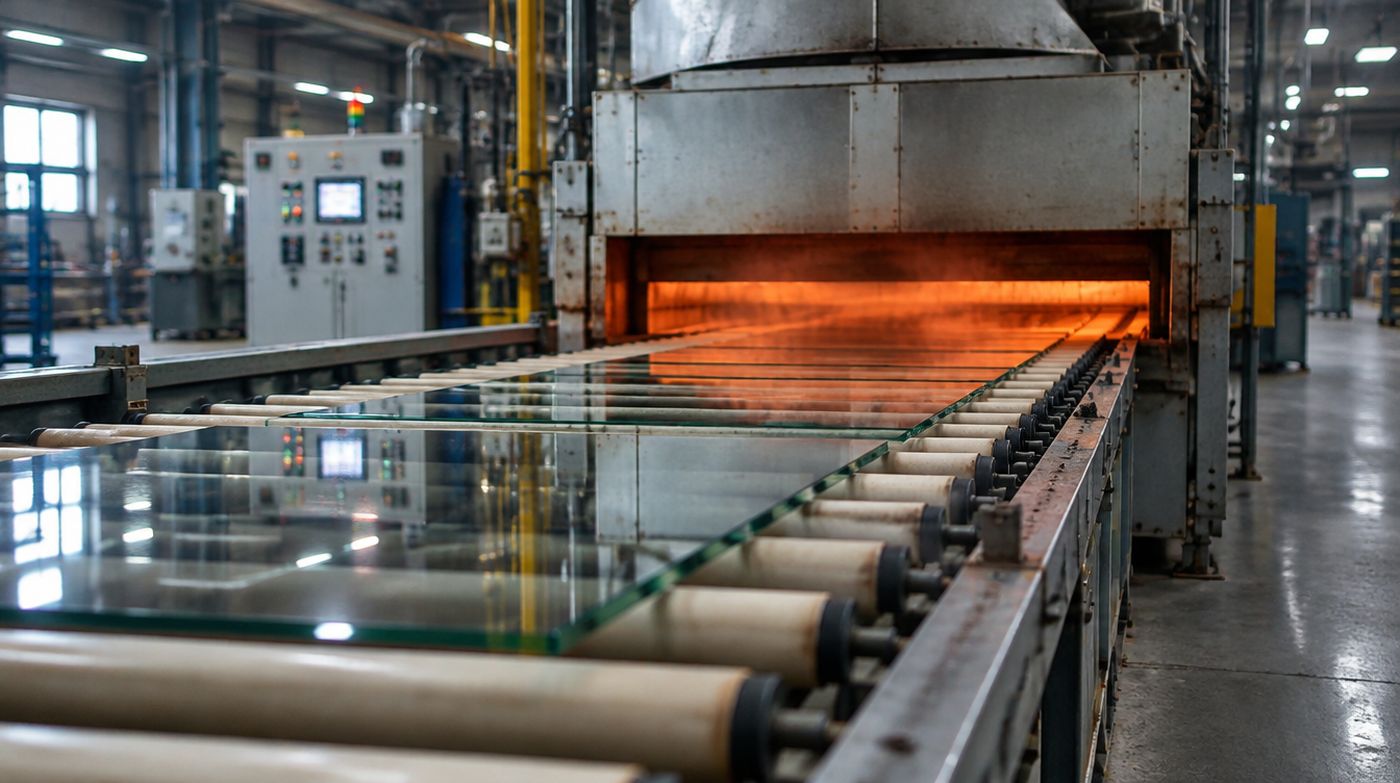
Toughened glass is not flat in the way annealed glass is flat. It travels through the furnace on rollers while it is soft, and the rollers leave a very slight ripple running across the pane in one direction. That is roller wave. The pane can also come out with a gentle overall curvature, which is bow. Both are inherent to the process and both are permitted within limits set by the product standard, so a pane with a visible ripple is not automatically a defective pane.
Where it matters is large glazing viewed at an angle, and above all shopfronts. Stand at the kerb and look along a shop window at a shallow angle and roller wave shows up as a lane of distortion in the reflected image of the street. Two panes next to each other with the wave running in different directions look like a mistake even when both are within tolerance. The way to avoid it is to tell the processor at order stage that the wave direction must be consistent across a run of panes, and to orient large panes so the wave runs horizontally where that suits the elevation. On a retail frontage this is worth specifying. On an internal door panel nobody will ever notice.
Edge quality is what decides whether a pane survives the furnace
The surface of toughened glass is strong. The edge is where it loses. Every chip, shell, flare and badly ground arris is a stress concentration, and when the pane is heated and quenched those are the points where it tears itself apart. A pane that breaks in the furnace, or breaks a week after installation for no apparent reason, is very often an edge work problem rather than a glass problem.
This is the main practical reason we process in our own workshop rather than buying in cut sizes. Cutting, arrissing, grinding and polishing happen under the same roof as the furnace, so the edge condition going in is controlled by the people responsible for what comes out. It also means we can hold a job while a measurement is checked instead of committing it to a batch that is already moving.
Heat soaked glass to BS EN 14179
Toughened glass carries a very small risk of spontaneous breakage from tiny nickel sulphide inclusions in the raw glass. Heat soaking is a second controlled oven cycle that provokes the unstable ones into breaking in the factory rather than in the building. It adds cost and lead time and it is not a universal upgrade. It is worth specifying where a spontaneous breakage would be expensive, dangerous or difficult to reach: large overhead or elevated glazing, panes above an entrance or a pavement, glass in a frontage that would have to be scaffolded, and anything where a shop would have to close to replace it. On a 600mm internal door panel it is money spent on nothing.
What toughened glass is not suitable for
Toughened glass has no post breakage retention. When it goes, the entire pane turns to fragments and leaves the opening. For a door panel that is exactly what you want. In other places it is unacceptable, and we will refuse to supply it rather than take the order.
- Overhead glazing, roof lights and anything over a walkway, stair, seating or display area, where falling fragments are the hazard. Laminated or toughened laminated, every time.
- Glass balustrades and barriers designed to BS 6180, where the barrier has to keep working after the glass is damaged. Monolithic toughened glass does not.
- Floor glazing, treads and anywhere a person stands on the glass.
- Positions where the pane also acts as security glazing under Approved Document Q. Toughened glass is strong but it is a single event away from being an open hole.
The other thing it is not suitable for is anything you intend to modify later. No cutting, no drilling, no notching, no edge grinding after toughening. If a joiner turns up with a pane and finds it is 3mm too wide, the pane is scrap.
Landlords, HMOs and when compliance gets asked about
The outline position for rented property in London is straightforward even though the paperwork is not. A landlord has to keep the property in repair and free from serious hazards, and glazing that would injure somebody who fell against it is exactly the kind of thing that gets written up. For licensed HMOs, and most London boroughs license more than the mandatory minimum, the inspection regime looks closely at escape routes. Glazed internal doors and glazed partitions along a protected route attract attention for fire performance as well as impact, and that is a different specification again.
What we can do is survey the building, list every opening that is a critical location, tell you which panes already carry a compliant mark, and quote in writing for the ones that do not. You then have a document to put in front of an inspector, an agent or a buyer. That alone settles most arguments.
How to order toughened glass so it does not get remade
Toughened glass cut to size is made once. Get the information right at order stage and it fits. Get it wrong and the whole lead time starts again, which on a boarded up shopfront is the difference between a quiet week and an expensive one.
- Rebate dimensions from the frame, measured at both ends and the middle, with the smallest figures used.
- Thickness, and what it is doing: a door panel, a side screen, a shelf, a splashback, a shopfront, a table top.
- Edge finish. Arrissed where the edge is hidden in a frame, flat polished where it will be seen or touched, as on toughened glass table tops.
- Every hole, notch, cut out and fitting position, dimensioned to centres, with the fitting type named.
- Which face is which if the glass is coated, low emissivity, patterned or obscured.
- Tolerance you can live with, and whether the pane has to match an existing one for distortion direction.
If any of that is uncertain, have it surveyed. As a toughened glass supplier in London with our own processing, we would rather send someone out with a tape measure for free than make a pane twice. Tempered glass is the same product under the American name, so if a drawing or a supplier calls for tempered glass in London, that is what we are making.
Survey is free across Greater London, quotations are written and fixed, and the work is done by our own installation teams rather than subcontractors. We are FENSA registered. Call 020 4634 6045, Monday to Friday, 8am to 5pm, or come to the workshop at 6 Atlas Road, Wembley, London HA9 0JH.
FAQ
Questions we get asked
How do I know if my glass has to be toughened?
Approved Document K defines critical locations: glazing in a door and in any side panel within 300mm of the door up to 1500mm from floor level, and any other glazing below 800mm from the floor. In those positions the glass must be safety glass, toughened or laminated, and permanently marked. Outside them it is a judgement about use rather than a legal requirement.
Can you toughen a pane I already have?
No, and neither can anyone else. Toughening is applied to glass that is already cut to its final size with every hole and cut-out in it. An existing pane cannot be put through the furnace and come back toughened. If you need toughened glass it is made from scratch.
Why can toughened glass not be cut?
The process leaves the surfaces in compression and the core in tension, and that locked-in balance is what gives the glass its strength. Breaking the surface anywhere releases it and the whole pane goes at once. There is no technique that gets round this.
My toughened panel shattered on its own. Why?
Spontaneous failure is usually one of three things: an edge chip that has been quietly growing, a fixing pinching the glass as the building moves, or a nickel sulphide inclusion inside the pane expanding over time. The third is rare and unpredictable, which is why heat soaked glass exists for applications where a failure would be serious.
Is toughened or laminated better?
They solve different problems. Toughened is stronger and cheaper, and when it fails it is gone. Laminated holds together on its interlayer, which is what you want overhead, in a barrier, or where security matters. For a door panel or a low window, toughened is usually the right call.
How quickly can you replace a broken panel?
We can usually measure within a few working days, and plain toughened panes are normally ready within a week of measuring. Patterned glass, thick sections and anything needing heat soaking take longer. If an opening needs making safe in the meantime we can arrange boarding.
Get a price for your toughened glass
Send sizes and tell us where the glass sits. We will confirm whether safety glass is a requirement and quote in writing.