Tempered glass in London, and what the word is actually telling you
If a quotation says tempered glass, it means toughened glass. The word is American, the product is covered by a British Standard, and the real confusion lies with the two other kinds of glass people mix it up with.
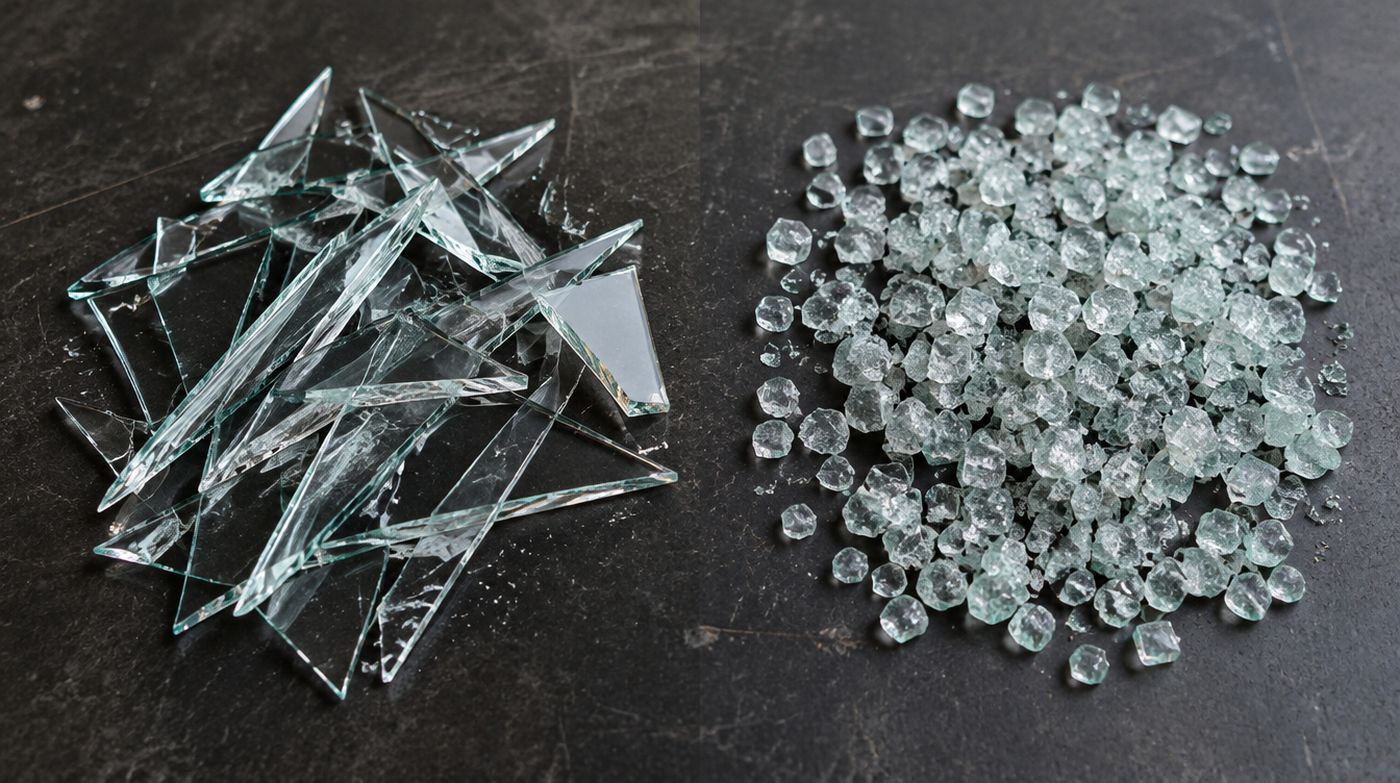
Tempered and toughened describe the same pane
Type tempered glass London into a search engine and almost every company that comes back will use a different word somewhere on its own pages. Tempered is the North American term for what BS EN 12150 calls thermally toughened soda lime silicate safety glass. Same furnace, same quench, same break pattern, same classification. In British usage it is toughened, in American usage it is tempered, and in a specification written by an architect working to both it can be either.
So the word on your quote tells you something about where the paperwork came from, not about the quality of the glass. If two quotes differ in price and one of them calls the product tempered, that is not a reason for the difference. You should never pay a premium for the American word, and if a supplier offers you tempered and toughened as if they were two grades of the same thing, that conversation is worth ending.
What matters instead is a short list of facts: the thickness, the standard the glass is made to, the safety classification it achieves, and whether the finished pane is permanently marked. We toughen in our own workshop at Atlas Road in Wembley and everything leaves with a mark on it.
What the furnace does, and what it costs you
Float glass goes into a horizontal furnace and is taken to roughly 620°C, close to the point where it starts to soften. It then passes into a quench where jets of cold air chill the surfaces fast while the core cools more slowly. The outer skins end up locked in compression and the middle in tension, held in balance. That stored stress is the whole trick.
The pane ends up several times stronger in bending than annealed glass of the same thickness, and considerably better at surviving thermal stress, which matters more in London houses than people expect. A pane that is half shaded by a projecting bay, or sitting above a radiator, or behind a dark blind, can crack from heat alone if it is annealed. Toughened glass shrugs that off.
The cost is flexibility and a little optical perfection. Once toughened, the pane cannot be cut, drilled, notched or edge worked, so every dimension and every hole has to be final beforehand. The rollers leave a faint waviness that shows in reflection on large panes, and the quench pattern shows as soft patches in polarised light. Both are inherent to the process.
And when toughened glass does break, it breaks completely. The stored energy releases and the entire pane dices into small blunt fragments, which is exactly what makes it a safety glass and also means there is nothing left in the opening. That trade-off decides a lot of specifications.
Annealed glass, and when the ordinary stuff is right
Annealed glass is plain float glass cooled slowly so that no stress is locked in. It cuts cleanly, it can be drilled and polished at any point, and it is much cheaper. It also breaks into long pointed shards, which is why it is barred from critical locations.
Away from those locations it is perfectly sensible and perfectly legal. Cabinet doors, picture glass, high level windows nobody can walk into, many mirrors and most internal glazing well above 800mm from the floor are all legitimate annealed applications. Replacing compliant annealed glass with toughened because somebody said it was safer is money spent on nothing in a first floor bedroom window. If that is your situation, say so to whoever is quoting, and ask them to point at the regulation that applies before you agree to the upgrade.
Heat strengthened glass is the one that gets mis-sold
Heat strengthened glass goes through the same furnace with a gentler quench. It comes out around twice as strong as annealed but it is not a safety glass, because it breaks like annealed glass into large angular pieces rather than dicing. It is a real product with real uses, mostly where thermal stress resistance is needed without the dicing break pattern, and as a component inside laminated makeups where you want the broken pane to hold together on the interlayer.
What it cannot do is satisfy a critical location. If a quote offers heat strengthened glass for a door panel, a side screen or low level glazing in a London flat, it is wrong, and saying so is the single most useful thing you can do with the information on this page. The giveaway is usually the paperwork: heat strengthened glass is covered by its own standard and does not carry a BS 6206 or BS EN 12600 safety classification on its own.
The other words that appear on the same quotation
Tempered is not the only piece of vocabulary that causes trouble. A toughened glass quote can carry half a dozen terms that people take as grades when they are nothing of the sort, so it is worth translating them.
Float is just the manufacturing method for the base glass, named after the bath of molten tin the ribbon floats on. Every pane discussed on this page starts as float. It tells you nothing about strength. Safety glass is a performance description, not a product: it means glass that has passed an impact test and achieved a classification, which toughened and laminated glass both can and annealed glass cannot. Class A under BS 6206, or the equivalent classification under BS EN 12600, is what you are looking for on the mark.
Heat soaked is a second process applied after toughening, in which the pane is held at a raised temperature for several hours. Its only purpose is to force out panes carrying a tiny nickel sulphide inclusion from the original melt, which is the one genuine weakness of the toughening process. It is standard practice on structural and overhead glazing and on glass above people in public buildings. On a splashback, a shelf or a door panel in a flat in Finsbury Park it is a cost without a benefit, and we will say so if you ask for it there.
Finally, the markings themselves. Look for a permanent mark naming the processor, the standard and the classification, with UKCA or CE marking on the documentation. A sticker is not a mark. A verbal assurance is not a mark. In a critical location the mark is the only thing that will satisfy a building control officer or a buyer’s surveyor years from now.
How to tell tempered glass when it is already in the frame
The reliable method is the mark. Toughened safety glass should carry a permanent stamp, either sandblasted or ceramic fired, usually in a corner, naming the manufacturer, the standard and the safety classification. It survives cleaning and it survives decades. Find it and you know what you have.
There are two useful secondary checks. Look at the pane through polarised sunglasses in daylight and you will often see faint dark patches or stripes, which annealed glass does not show. Look along the surface in reflection and you may see the gentle waviness the rollers leave. Neither is proof, but together with a worked edge on all four sides they are a strong hint.
What you cannot do is tell by tapping the glass, by its thickness, or by how it looks from across a room. Anyone willing to declare a pane toughened without finding a mark is guessing, and we are called out to a fair number of these in Camden, Hackney and Haringey conversions where glazing was swapped at some point and no paperwork survives. It tends to surface at a survey or a sale rather than at a convenient moment.
Tempered glass London: where it belongs, and where it does not
In a typical house the clear cases are doors and the panels beside them, glazing below 800mm from the floor, shower screens, internal partitions, shelves, splashbacks behind a hob and table tops. Our panels and doors pages go into the specification for each of those properly rather than repeating it here.
The cases where toughened glass is the wrong default are the ones worth knowing. Overhead glazing generally wants laminated glass, because a pane that dices above your head leaves an open hole and a shower of fragments. Barrier glazing designed to hold a load under BS 6180 often wants a laminated makeup for the same reason. Anything where security rather than safety is the point wants laminated too, because dicing is not a deterrent. Laminated glass is a separate subject and we deal with it separately.
Toughened and laminated are not competing grades. One decides how strong the glass is. The other decides what is left when it breaks.
What to do when the quote says the wrong word
Ask three questions and the terminology stops mattering. First, what thickness and what standard, with the safety classification stated. Second, who actually toughens it, because a supplier who cannot say is reselling somebody else’s pane with a margin on it, and we expand on that on our supplier page. Third, will the finished pane be permanently marked.
Put them to any tempered glass London supplier you ring, including us. A supplier who answers all three in one sentence is fine whichever word they use. A supplier who deflects on any of them is a problem regardless of how good the price looks. For our part we would rather send you away with annealed glass and a cheaper bill than toughen a pane that did not need it, and we will tell you when that is the case.
FAQ
Questions about tempered glass london
Is tempered glass the same as toughened glass?
Yes. Tempered is the North American name and toughened is the British one for the same product: float glass heated to around 620°C and quenched with cold air so the surfaces hold compression and the core holds tension. In the UK it is made to BS EN 12150 and classified as safety glass under BS 6206 or BS EN 12600. There is no difference in strength, break pattern, thickness range or processing between a pane called tempered and a pane called toughened. If a quotation prices them differently as though they were two grades, the pricing is wrong rather than the glass.
What is the difference between tempered and heat strengthened glass?
Both go through the same furnace, but heat strengthened glass is quenched more gently, so it ends up roughly twice as strong as annealed rather than several times stronger. The important difference is the break pattern. Tempered glass dices into small blunt fragments, which is what qualifies it as a safety glass. Heat strengthened glass breaks into large angular pieces like ordinary glass, so it does not achieve a safety classification on its own and cannot be used in a critical location such as a door panel or low level glazing. It is mainly used for thermal stress resistance and inside laminated makeups.
Can tempered glass be cut or drilled after it is made?
No. The pane is held together by a balance of compression in the surfaces and tension in the core, and any cut, drilled hole, notch or ground edge breaches that balance and releases it. The pane does not chip, it disintegrates. This is why every dimension, every radius, every notch and every hole for a hinge, lock, handle or standoff fixing must be finalised before the glass enters the furnace. If you need a change after the fact, the pane is remade rather than altered, so it is worth checking the written sizes carefully before anything is cut.
Get a price for your toughened glass
Send sizes and tell us where the glass sits. We will confirm whether safety glass is a requirement and quote in writing.